

Legacy of Harm
Failed Federal Policies Are Still Undermining Schools
Schools should have clear rules, fair consequences, and safe classrooms. But Washington made school discipline about something else.
For years, federal officials pressured schools to treat racial disparities in school discipline as proof of discrimination, even when schools applied the same rules to every student.
Schools got the message. Districts replaced clear consequences for poor behavior with methods sold as “restorative justice,” “social emotional learning,” or “alternative discipline.” These programs dramatically undermined school safety and student performance. In some cases, they even introduced a toxic, race-based ideology into classrooms.
President Trump rescinded the Obama/Biden mandates, but the practices did not go away. In fact, they’ve gotten worse.
Federalism in Action’s investigation found:
- 500+ districts are still using these frameworks. Our review found hundreds of districts in at least 40 states still operating under failed and dangerous discipline practices.
- Classrooms are paying the price. Research shows restorative justice programs have worsened student achievement and made students feel less safe.
- Teachers are being undermined. Documented complaints include students using alternative discipline spaces to avoid instruction and misconduct going unaddressed.
- Taxpayers are funding the experiment. The report found millions in spending, including $2.6 million to San Antonio ISD for student “Peace Rooms.”
- Ideology entered through the back door. Some “restorative justice” programs introduced classroom exercises on race, gender identity, and environmental policy that had little to do with discipline.
Tell state leaders to investigate these programs and restore safe, orderly classrooms.

Restore Safe, Orderly Classrooms
Students deserve schools where teachers can teach and students can learn.
Add your name to urge attorneys general, lawmakers, and education officials to investigate how restorative justice and alternative discipline programs are being used in their states.
Need Help Investigating These Policies in Your State?
Federalism in Action can help state and local leaders uncover how restorative justice, social emotional learning, “Peace Rooms,” and alternative discipline programs are being used in their schools.
If you are an attorney general, lawmaker, school board member, education official, or local leader, FIA can help you:
- Identify districts using race-based or alternative discipline frameworks
- Review grant programs, contracts, training materials, and district policies
- Develop oversight questions for agencies, districts, and vendors
- Examine whether programs comply with state law and protect student safety
- Build a state-level strategy to restore safe, orderly classrooms
These policies did not disappear when federal guidance changed. They remain embedded in district practices, staff roles, vendor contracts, grant programs, and training materials.
If you want to know what is happening in your state or community, contact FIA.

How D.C. Changed School Discipline
In 2014, the Obama administration warned schools that racial disparities in suspensions and expulsions could trigger federal civil rights scrutiny, even without evidence of discriminatory intent.
That turned discipline into a racial numbers game. Administrators began to think less about maintaining safe learning environments for all children, and more about how to produce the numbers Obama’s staffers wanted to see.
The Biden administration later revived and expanded the race-focused pressure, pairing it with more than $100 million in federal grants for already-failed alternative discipline programs. President Trump rescinded the mandate, but the programs built around it remained.
The guidance is gone, but the system it created is not. Many school districts simply kept the old system in place through policies, staff positions, contracts, training materials, grants, and school-level practices.
What Race-Focused Discipline Looks Like in Schools
The problem starts with discipline. The ideology follows.
1. Misconduct gets diverted instead of addressed
Many restorative justice and alternative discipline programs replace ordinary consequences with conversations, reflection exercises, cool-down spaces, or other diversionary practices.
Federalism in Action found complaints from teachers and staff that students used these spaces and passes to get out of class, enjoy “free fun time,” and avoid accountability. One staff member said there was “no learning happening” and “no real accountability.”
2. Classroom authority breaks down
When schools are pressured to reduce discipline numbers by race, the quickest fix is to reduce consequences across the board. Teachers and principals get discouraged from enforcing clear consequences.
The investigation found evidence that weakened discipline has contributed to disorder, safety concerns, learning losses, and teacher morale problems. It also found research suggesting restorative justice may worsen the disparities it claims to solve.
3. Taxpayer-funded peace rooms
Federal grants helped districts hire restorative justice staff, create alternative discipline rooms, buy supplies, and train teachers in race-conscious discipline models.
San Antonio Independent School District, for example, sought roughly $2.6 million for “Peace Rooms” on 35 campuses, including 30 positions, furniture, sensory tools, and other supplies. These rooms were designed to help students process “big feelings,” repair relationships, and avoid punitive discipline.

4. Staff are trained to view discipline through race
In Austin Independent School District, a draft guide indicated that full implementation of restorative justice required a restorative justice associate to present “self as a racial being” and model conversations about race with educators.
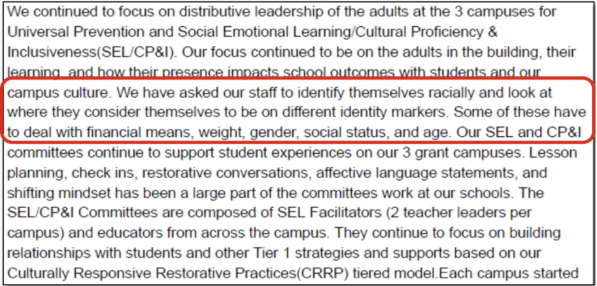
Other materials asked staff to identify themselves racially and examine where they fell on identity markers such as financial means, weight, gender, social status, and age.
5. Ideology enters the classroom
In Austin ISD, students were directed to answer prompts about “white privilege” and what they could do to help dismantle “white privilege and cultural privilege.” Those questions have little to do with whether a student disrupted class or violated school rules. They show how discipline reform became a vehicle for political and racial ideology.

Why This Matters
The promise was safer schools and better outcomes.
The reality is weaker accountability, lost learning time, frustrated teachers, and students who feel less safe.
These policies were promoted as a way to help minority students. But Federalism in Action’s executive summary documents rising classroom disorder, worsening racial disparities in student outcomes, academic decline, and teacher attrition tied to the Obama/Biden discipline approach.
When schools abandon consequences, students suffer. Teachers are not supported. Classrooms are not safer.
State Leaders Can End It
Washington created this problem. States can clean it up.
Attorneys general, lawmakers, education officials, and school boards can review grants and contracts, hold oversight hearings, enforce state law, demand records from districts, and make clear that schools should teach children and keep them safe, not pursue a twisted vision of racial justice.
State attorneys general can issue legal opinions, investigate districts, and bring enforcement actions.
State lawmakers can hold hearings, audit district compliance, review federal grants, and clarify that school discipline must serve the interests of students, parents, and teachers, not DC ideologues.
School boards and district officials can end contracts, review training materials, eliminate race-conscious policies, and restore clear consequences.
The federal mandate is gone. Now state leaders must remove the system it left behind.

Add Your Name
We are urging attorneys general and state leaders across the country to end race-based restorative justice discipline in public schools.
Add your name to show them that people in your state are paying attention.
By signing up, you agree to receive updates from Federalism in Action about this investigation and related state-level efforts.

Share Your Story
Have you seen race-based discipline, restorative justice, social emotional learning, “Peace Rooms,” or alternative discipline policies affect your school?
Federalism in Action wants to hear from parents, teachers, students, school board members, and district staff.
Your story can help state leaders understand what is happening inside schools and why action is needed.